

In a Kind of Purgatory
Updated: Jan 27
1
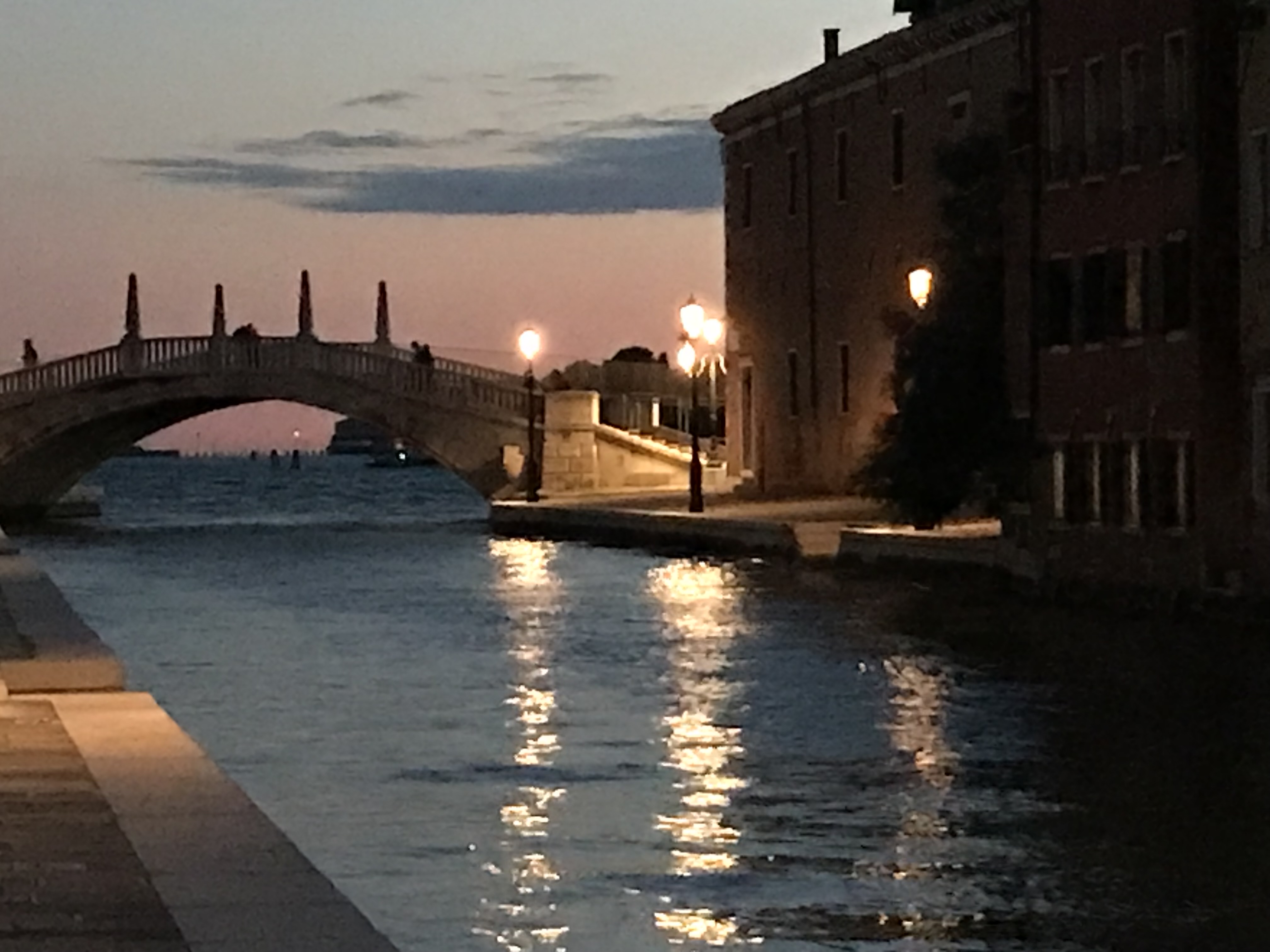
I was painting on the island of San Giorgio Maggiore by the sailboat marina. The day was drawing to a close. My watercolor was taking shape, the blue gray canal set against a strip of stucco buildings rendered in ochre and red. I didn’t hear the humming until it became a buzzing sound. Fifteen feet above the marina, a drone headed towards the lighthouse entrance. On the marina, a man stepped out of his boat and walked over to the woman operating the drone.
“Excuse me,” the man said. “Do you have a permit?”
“A permit,” the woman repeated.
“For the drone.”
“I didn’t know.”
The woman brought down the drone, folded and packed it in her knapsack; then left with camera in hand along with her two companions. The man returned to his boat. I continued to paint, matching the gray in the canal as the color turned blue white in the trail of a police boat.
2
Days later, an explosion interrupted the Venice Biennale at a collateral event inside a palace on the Grand Canal. People reported minor burns. Damage to the palace was limited to broken glass in the room with the artwork. Authorities sealed off the area and suggested that a gas leak might have been the cause. I had my own hypothesis, that the explosion was related to the drone incident. How this connection came to mind is a mystery given that I am not prone to conspiracy theories.
The incident replayed in my mind, which made me think of what the woman was doing before launching the drone. You would expect anyone visiting Venice to take photos. It’s not something you would think twice about unless you suspected some other intent.
“What did you see?” the detective asked.
“Aside from the unusual sight of a drone in the heart of Venice,” I said, “there was something else, like someone casing out a location.”
“And...”
“A possible connection to the Biennale explosion.”
“How so?”
A good answer eluded me, but the detective proceeded to take notes along with my name and address in Venice. The muscles in my neck tighten.
3
In Dorsoduro, a small square became the scene for another watercolor, the lower façade of a church with detail around the window and relief, its pale-yellow walls behind a pink marble cistern framed between a tree trunk and a lamp post. The purple color of the cistern top worked with the shadows on the cobblestone. The interaction of colors engulfed me, displacing my suspicions except for one.
Someone was following me, I thought.
My only local connection was with an Italian artist I had met while attending the Biennale.
“Thoughts?” she asked.
“Are you talking to me?”
“I was curious to see if you would come up for air.”
“And you are...”
“Chiara. Now that I have your attention, what were you thinking?”
“Like ghosts in a kind of purgatory.” I hesitated to say more beyond introducing myself.
Chiara opened her short guide to the Biennale, and after finding Pawel Althamer, read how the artist used gray ribbons of plastic to create life-size sculptures of Venetians in this installation. She went on to say how his sculptural work represents the human experience by proxy. My mind filled with a collage of words.
“Noah,” Chiara said. “Are you with me?”
My mind was elsewhere, maybe in that collage of spirits and other souls lost in an eerie world suggested by the installation. My mind meandered until I heard her voice again.
We spent the rest of the day critiquing the contemporary art on exhibit, and in the Castello district, sustained the exchange during dinner, al fresco, over a whole Branzino with roasted potatoes and Chardonnay. The Chardonnay appeared more gold than yellow. Its peach aroma appealed to me. Chiara insisted on cleaning the fish. We lingered at the restaurant, listening to the owner’s rendition of 'O sole mio, which moved me to fields of sunflowers. Maybe Chiara saw me in the sunshine. I extended a smile to her. We applauded, and before leaving, settled on a date to meet at the Lido.
Even at midnight, Venice was safe. The persistent thought of being followed however is another matter altogether. En route to my apartment, I turned into an alleyway, speed walking to the other end where a police officer was lighting his cigarette.
4
My morning routine started at the newsstand, buying Il Gazzettino to learn more Italian but also to catch up on local news while sipping cappuccino.
Two mornings had passed since seeing Chiara, which made me think about her. I imagined that she would find me at this outdoor café. That thought scattered when I read something about another explosion, directed at a line of gondolas parked along St. Mark’s Square. I could not have imagined the police here, no less the same detective who took my statement from the other day.
“… last night?” the detective asked.
“What was that?”
“Regarding our last visit, in light of the gondola explosion.”
“You’re mistaken if...”
“Your whereabouts is all we need right now.”
“I retired early, after experiencing body aches and chills.”
“Can someone vouch for you?”
“The pharmacy over there. Whoever was working last night would remember my broken-Italian for anything that would help. I can show you a receipt for the Oscillococcinum.”
“Don’t leave Venice until we get back.”
5
At a Lido beach, the early morning waves rolled over the sand and pebbles to produce a kind of chanting, which inspired me to paint.
Red umbrellas over white chairs facing calm water and a jetty in the distance became the core of the painting. Behind that, an empty lifeguard tower and flags finished the composition. The texture of the sand added depth. I fell into a flow that concentrated my attention only on the watercolor. I can’t say how long it lasted, only that it ended when a yellow balloon floated across my set.
Trial balloons, I thought.
The explosions could represent trial balloons for another target, perhaps the upcoming concert in St. Mark’s Square. I had tried to get tickets to the venue, a night of Italian opera. There’s no way I could go back to the police. Chiara would understand the mind of an artist, how we see connections that escape others.
“Bravo,” Chiara said. “Your watercolor is so serene.”
We talked about our work and the challenge of finding places to exhibit. She knew something was bothering me. I confided in her. Chiara told me that her uncle has an apartment with a view of St. Mark’s Square. We could use the place, she said, and with binoculars scan the concert for any sign of trouble.
6
High ceilings and minimal furnishings created an openness throughout the apartment. I liked the parquet floors but was surprised that the walls had only a few prints, not even one painting. We could see the concert stage and the surrounding seating from three wide windows in the living area.
Contemporary, I thought.
The crowd settled into their seats as the concert was to begin.
Why we were there fell away as the voice of the tenor filled the Square. La donna è mobile highlighted the evening, its melody danced with the audience. He was in his flow and extending a hand to join him – unconstrained, fluid, ethereal. Toward the end, the lights flickered and illuminated the couple from the sailboat marina.
“I’m calling the police,” I said.
“Why? Nothing rises to an alert, from that couple or anyone else,” Chiara said.
The police on the ground continued to hold their positions. Nothing had changed until I heard the buzzing and saw the drone outside the apartment.
7
I found myself outside on the ledge of St. Mark’s Campanile. My position, on the pyramid part of the bell tower just under Archangel Gabriel, made it difficult to navigate down. Below were the Venetians, the sculptures extending their hands. Chiara called out from inside the tower.
“Noah!”
“Are you seeing this?” I asked.
“What are you thinking?”
“We were on the Lido; then at a concert. Joyful is how I experienced the music. This is going to sound crazy. The joy became so intense that I had this curious feeling of floating until I heard the drone.”
“And…”
“That’s when everything turned sideways.”
San Giorgio Maggiore, Rio Dell'Arsenale - photographs by author
R G Pagano lives in Newton, Massachusetts. He resided in Italy for a time and often travels there with his wife, drawing on those experiences. His work has appeared in The Account: A Journal of Poetry, Prose, and Thought; Harrow House Journal; Lunch Ticket; Thirteen Bridges Review; and Italian anthologies Ho Girato il Mondo per Incontrarti and Nei Miei Occhi, Tu. His debut collection of poems, Burnt Fields Under Snow, is forthcoming from Kelsay Books in 2026.


Comments